Sunday, 11 August 2024

Part Sherlock Holmes. Part Columbus

This is what I enjoy about my work- the fun of discovering new things and the joy of connecting them.


While glancing through the latest annual report of HDFC Bank , among the many photographs out there, I curiously stopped at this one. 'Jal Minar' provides drinking water to the rural population of a village. Nice name. Jal Minar like Qutub Minar


HDFC Bank has joined hands with Sehgal Foundation to install this. 
I became curious about the Sehgal Foundation. Who set it up ? What does it do ?

Sehgal Foundation was set up by Dr Surinder (Suri) Sehgal and Dr Edda Sehgal to improve the quality of life of the rural communities in India.

Dr Suri Sehgal and Dr Edda Sehgal are crop scientists and experts on hybrid seeds. They set up Proagro group (seeds company) which was later acquired by Bayer. They decided to use their wealth for philanthropy and set up the Sehgal Foundation.
Don't forget to watch the story of Dr Suri Sehgal The American Story

The foundation's website looks pretty comprehensive and in the spirit of transparency, a host of information is available on the website including audited financials going back many years. Curiously, I checked a few of them and found the name Lady Bamford Charitable Trust as one of the donors. This name sounded a little unusual and I further checked about this name.

This trust has been set up by Lady Carole Bamford. She is married to Lord Anthony Bamford who is the owner of a heavy equipment manufacturing company.


The name of the company is J C Bamford Excavators Limited or simply JCB. Oh, JCB I have heard and seen it all the time.

I didn't know that B in JCB stands for Bamford.


HDFC Bank > Sehgal Foundation > Lady Bamford > JCB
As I said, Business analysis is part Sherlock Holmes, part Columbus and a lot in between.

Monday, 15 July 2024

GREED IS IN THE AIR

Anybody with even a slight interest in the equity markets will know that there has been a party going on in that arena for the last couple of years. With every passing month, the noise decibel has been only going higher. There was a small interruption on June 4 post the election results but it seemed that the cops had turned up to see if all the approvals for the party were in place. And after the cops left the venue, the emboldened party goers went into a frenzy.


What do the valuations look like ?

I tried to compare the historic Nifty PE valuations with the current valuations to gauge the margin of safety. As per this note, it might not be prudent to rely on that comparison since NSE switched the earnings calculation method in April 2021.

Standalone versus Consolidated: NSE published standalone PE for the NIFTY up until March 2021. Starting April 2021, they switched to using consolidated earnings to calculate the NIFTY PE ratio. Therefore you see in the table below, a dip from 40.1 in March 2021 to 32.7 in April 2021. This means the NIFTY PE ratio now is not directly comparable to the PE ratio before April 2021. Any analysis that draws a relationship between historical returns to prevailing PE ratios can't be directly be applied to the current NIFTY PE Ratio.
[Source : Capital Mind]
So, I will leave it at that and look for some other signals.

Let's, look at the IPO subscriptions. Promoters are most knowledgeable about their businesses and they know the right time to cash their chips. Read this and this. Opportunistic promoters are taking money home by selling shares while the exuberant investors, particularly the small investors are falling head over heels while deploying their money in the stock market.

Another signal is the sheer number of first time investors who are entering the market. These investors have not experienced any sustained bear market and they don't know how stomachs churn when stocks fall down by a large percentage. In the past few months, I received hurried calls from a couple of my friends (who are very successful businessmen but have no clue about the stock market) to understand how to invest in stocks. Their enthusiasm makes me nervous and I don't think I was successful in tempering it.

The last signal for me is the lack of margin of safety in the valuations of businesses I like and would be open to investing. Since the valuations are not in my favour, I have no other option but to wait.

How long will you wait ?

I look for businesses that (1) I understand (2) earn an attractive economic return (3) are run by quality managements & (4) are available at a reasonable price. I will not invest till ALL the above conditions are met. I have been waiting to make an investment of a significant size and the current valuations are making the wait longer. I am prepared for that and sincerely hope that my clients are with me on this.

If you don't invest, what do you do in the mean time ?

I show everyday at my work with enthusiasm and remember Prof Donald's Sull's idea of active inaction. "Inaction does not have to mean that nothing is going on. When troops are not in battle, they keep themselves in a state of active preparedness." I am trying the same.
I read up on new businesses, review the existing ones, exit the ones which I think were a mistake or are not as good as I thought earlier.

Are you making a market forecast that the market will fall substantially ?

No, I am not. I am also sure that nobody can forecast that. All I am saying is that multiple signals have turned yellow and risk reward is not favourable. Hence, it is prudent to be cautious.

What does Rapper Badshah has to do with all this ?

All work and no play makes Ankur a dull boy. Since I don't want this note to be dull, I will end this with a groovy & peppy number by Rapper Badshah "Abhi to party shuru hui hai

He says in the song :

Baad mein na kehna, pehle hi de doon warning
party chalegi till 6 in the morning....

I know the party is on. I don't know if it will go till 6 in the morning. But I think there is a high chance that whenever it ends, it will result in a bad hangover. 

Saturday, 30 December 2023

Mind at the crossroads

What should one do when the facts change and the original thought process doesn't hold any longer. As an investment professional, situations that warrant a change of mind come with a little higher frequency. New facts emerge and decisions have to be constantly revisited in light of those. In this post, I have listed down a few quotes that I remember and questions that I ask which help me decide. It's possible that you too may find them useful in your decisions, investments or otherwise.

When the facts change, I change my mind. What do you do, Sir ?

This quote from Keynes has been my guiding light when I have to make decisions in the light of new facts.


The other person's viewpoint seems more rational and logical than mine. How should I handle my ego which prevents me from accepting it?

Focus on what is right, not who is right. If my existing point of view is inferior to an alternate view point, I should immediately latch on to the better one. Knowledge like sunshine should be welcomed from all directions. It doesn't matter who the person on the other side is. Focus only on what is right.


How long will this change be required ?

Till my last breath. Munger of his own admitting made the worst investment mistake by investing in Alibaba during the last few years of his life. But when he realised he was wrong, he quickly sold his investment and didn't fall for commitment. Even in his last years, he taught an important lesson through his actions. If you realise you are wrong, change the course. Period.


What is my North Star while investing ?

I consider the investment thesis (moat around the business, its sustainability, the track record in terms of return on capital, risks and the quality of management) as the North Star. In a plethora of decision making points, I look upto my North Star. If the investment thesis continues to be as I thought earlier, no change is required even if the market doesn't agree with me for years together. I tell myself that I should be patient, stay put and not disturb the position. 


What should an ideal mind be like ?

An ideal mind should be like a spider's web. As soft as silk but stronger than steel. When conditions warrant, the mind should change itself effortlessly. However, when nothing has changed, it should be as hard as steel. Unmoved and firm. Like Angad's leg.


Should you change your mind about an investment idea, what about loss of face in front of the clients?

It's better to look foolish than to stay foolish.

Sunday, 14 May 2023

DESTROYED

“Any year that you don’t destroy one of your best loved ideas is probably a wasted year” – Munger

Many years back, I destroyed something in my mind. It was neither good nor an idea. It was a prejudice – a wrong notion. The notion to discriminate members of the LGBT+ community. How I picked it up, I don’t know. Most likely from the society around me. The general behaviour of people is to discriminate and mock members of the LGBT+ community. Reason- they are different from us and don’t fit into the established norms of the society. I started behaving like others around me. Monkey see, monkey do. I regret that behaviour of mine. 

Over a period of time, the debates and discussions on TV and newspapers sensitised and educated me. I questioned my beliefs and I could see no good reasons to continue holding such beliefs.

Companionship is the most important physiological needs of a human being. Having a companion is a primal urge. According to a Biblical story, Eve was created by God by taking her from the rib of Adam, to be Adam's companion. Companionship is all about meeting of the minds, vibes, chemistry and frequency. Sexual orientation has nothing to do with it. 

The case for legal acceptance of same sex marriage in India is with the Supreme Court now. The court has finished hearing arguments and the verdict is awaited. Marriage equality would be a giant leap in making our country more equal. Every citizen in India enjoys freedom under the constitution. Choosing one’s marriage partner should be one such freedom.

As I finish writing the post and wait for the court’s verdict, I wish all my brethren of the LGBT+ the best and recite the following lines from the poem ‘Gitanjali’ by Gurudeva Rabindra Nath Tagore.

“Where the mind is without fear and the head is held high;
Where knowledge is free;
Where the world has not been broken up into fragments by narrow domestic walls;
Where words come out from the depth of truth;
Where tireless striving stretches its arms toward perfection;
Where the clear stream of reason has not lost its way into the dreary desert sand of dead habit;
Where the mind is led forward by thee into ever-widening thought and action -
Into that heaven of freedom, my Father, let my country awake"

Tuesday, 31 January 2023

To Short or Not?

I don’t have any holding long or short in the Adani group shares. This note is to talk about shorting in general, my own experience of short selling and finally Buffett’s wisdom on shorting.

Adani Group stocks have been roiled in the last couple of days post the publication of the Hindenburg Report. Hindenburg is a US based short seller specializing in finding companies which it suspects to be fraudulent or having financial irregularities. The research house goes short on these companies, publishes it reports and makes money if the stocks go down.


What is Short Selling?

Normally, when we buy shares of any company, we expect the prices to go up over a period and thus make money. This is known as long investing. Short sellers on the other hand sell shares of the company they don’t have [either by borrowing shares from other owners or selling in the futures market] and buy them back when the price goes down thus making money in the process.

Simply put long investors FIRST buy low and THEN sell high. Short sellers FIRST sell high and THEN buy low.


Perils of short selling

The first danger of short selling is the potential for unlimited losses. In the case of long investing – say you buy a stock at Rs 100. The worst-case scenario is that the stock can go down to zero. So, your maximum loss is pegged at 100. You can’t lose more than what you had invested.

In short selling, the potential for losses is unlimited. Say you short sell a stock at Rs 100. Theoretically, the stock can go up to any price and so can your losses. 

The second danger in short selling is absence of staying power. In long investing, one can invest and stay patiently in the position for a long period of time. In short selling, if the position moves against you, you will have to keep pumping more money to cover your losses. The requirement of more money to stay in the game might severely constrain your position and you may have to bow out early [and wounded] even if you are eventually proven right.

Markets can stay irrational longer that you can stay solvent ~ John Maynard Keynes

The third and most lethal danger of short selling is the possibility of a short squeeze. As I wrote earlier, in short selling the intention is to sell high and buy later at a lower price. Imagine you sold some stock at a high price and instead of price going lower, it goes higher and you have losses. You decide to take your losses, lick your wounds, and close out the position. For closing out the position you need to buy back the same quantity of shares which you had sold earlier. When you wish to buy the shares even at a higher price, to your surprise you find that there are no sellers in the market. The stock is locked in upper circuits day after day. The whole thing defies gravity and turns into a vicious loop.

There have been many examples of short squeezes in the capital markets. The one which is etched in my memory is that of Volkswagen. The German billionaire Adolf Merckle, the owner of Porsche tried to take over Volkswagen (VW). Amongst many steps that he took, one was shorting the shares of VW in the market but the tide turned against him and shares of VW kept marching up. With no shares of VW available in the market to cover up, the losses in the position mounted uncontrollably. The monetary and reputational loss was so high that Mr Merckle took his own life.

It's insane to risk something that you have and do need for something that you don’t have and don’t need- Warren Buffett


My experience of short selling

Soon after I started investing in the year 2004, being largely ignorant about the ways of the market, I took short positions in 2 companies because I found the valuations expensive. However, the prices went up considerably and I received a margin call from my broker. I had to liquidate my savings in the bank to fund the margin and eventually to close out the positions. The time I spent in that position was extremely unpleasant with sleepless nights. Having learnt my lesson that the odds are stacked against the investor in short selling, I decided not to do it again. I behaved like Mark Twain’s cat and haven’t touched the stove since.

All I want to know is where I’m going to die so I’ll never go there- Anonymous Hermit


Buffett on short selling

I have kept the best part for the end. I am sure you will relish and learn what Buffett has to say on short selling stocks. Credit for the following excerpts: Outstanding Investor Digest [OID]





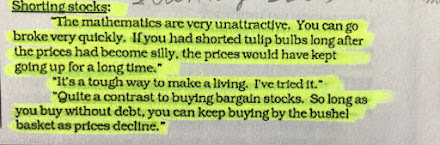

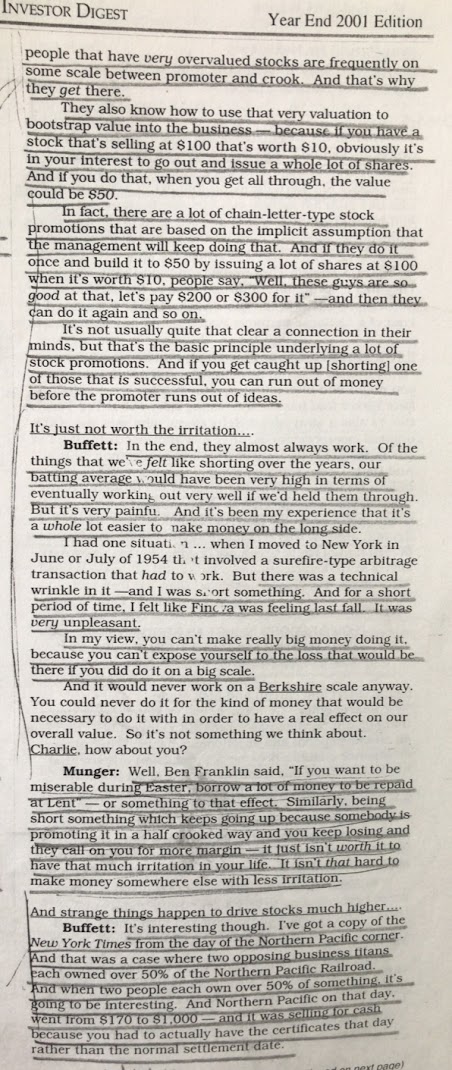

Friday, 18 November 2022

In search of the Sangam

Prayagraj [earlier Allahabad] is the city where the 3 holy rivers Ganga, Jamuna and Saraswati meet and their confluence is the 'Sangam'.

Where is the Sangam in the field of investing?  
Go no far. Read what Buffett wrote in 1992 in the Berkshire Shareholder Letter:

"Leaving the question of price aside, the best business to own is one that, over an extended period, can employ large amounts of incremental capital at very high rates of return."
This is the trifecta which one should be looking for. True 30 years back, true today and will be true 30 years later. It's simple to read and understand but takes a lifetime to internalise and practice.

While thinking about this topic, analogy of a fruit bearing tree comes to mind. Compare a fruit bearing tree with a business. The roots of a tree are similar to the moat/competitive advantages of a business. Only if the roots are strong, will they hold the tree against natural adversities like droughts and storms. Roots provide longevity to a tree. Same way, only if a business has strong competitive advantages, will it hold fort against economic headwinds, competition and the like.

Next, fruits of a tree are akin to the ROCE [Return on Capital Employed] of a business. What good would a tree be if its roots are strong but it doesn't bear fruits? So, a good tree should have strong roots and should produce bountiful fruits. Similarly, a good business should have a strong moat which should reflect in healthy returns on capital.

Last in the trifecta is growth. A good tree should have strong roots, bountiful fruits and should have fruits with healthy seeds which can be planted elsewhere to compound into more trees. Similarly, a good business should have a strong moat, healthy returns on capital and the opportunity size large enough to continually deploy the incremental capital at good rates of return.

The confluence of these 3 is the Sangam of Investing. It produces the proverbial nectar, compounding of wealth and leads to investment nirvana.

There are many different ways to invest sensibly. Here, I am talking about investing in good quality businesses which I personally practice.

Saturday, 25 December 2021

Thou shall value holding companies at a discount but not always

Shriram Group announced a restructuring of the group companies on Dec 13, 2021. The restructuring entails merger of listed operating companies Shriram Transport Finance (STFC) & Shriram City Union Finance (SCUF) and an unlisted company Shriram Capital (post the demerger of insurance and other non-lending businesses).


A couple of concerns which have been raised in the media about the restructuring:


  1. Holding of Shriram Ownership Trust (SOT)-the promoter in the merged entity would be ~12%, which is considered low by some observers. Low enough that they have contemplated a ratings downgrade by rating agencies. 


I am not well aware about the mechanics of ratings but by simple logic, the number of shares held by SOT pre restructuring and post restructuring remain the same. The trust has not sold a single share in the last so many years. In fact, it has added to its share count by buying shares of SCUF from the open market in 2020 (here), buying shares of STFC in 2019 and infusing additional capital in STFC through preferential issue of shares (here). If the rating agencies were fine with the number of shares held by SOT earlier, why should it create a problem now when SOT has higher number of shares?


We also have a case of HDFC Limited which is a lender with no identifiable promoter. Directors and employees of HDFC Limited own a stake which is in low single digits. The majority shareholding in HDFC rests with institutions and foreign investors. 


If no identifiable promoter and low shareholding of employees is not a concern in the case of HDFC, how should it be a concern for the merged entity of Shriram where there is a clearly identifiable promoter and employees (through a Trust) own a ~12% stake? 


  1. The second concern is about the discount which should have been given to Shriram Capital while merging the same in the restructuring. The rationale is that Shriram Capital is a holding company and holding companies sell at a large discount to their intrinsic values, hence Shriram Capital should have been valued at a discount in the restructuring scheme.


It's not a Biblical commandment that holding companies should be valued at a discount. Holding companies sell at a discount because shareholders in them neither get access to the cash flows of the investee companies nor they fully enjoy price appreciation of the investee companies since the investments are never sold /unlikely to be sold. Hypothetically, if a holding company were to announce a scheme where it would be wound up and the shareholders would get their proportional share of the investments which they can freely sell in the market- the discount to the intrinsic value of the holding company would evaporate in no time (ignoring frictional costs and taxation). 

In the case of Shriram Capital, it was a privately owned investment vehicle which held investments in STFC and SCUF. In the merger, the investments are being proportionally allocated to the shareholders of Shriram Capital. I believe it’s a completely fair game and there is no reason for a discount to be present in the restructuring scheme.


  1. The third concern is about the challenges which the merger can throw both in terms of HR integration and business integration. This is a valid concern and only time will tell how the dust would settle. However, on a probabilistic basis the odds are higher that the merged entity should be able to handle any such challenge given the strong pedigree of the business and the management.


(This post is not an investment advice. It is meant for discussion purposes only. My clients and I are invested in both STFC and SCUF)